For most of maritime history, ships have transited the Strait of Hormuz for free. No toll. No permit. No fee to a sovereign authority. That era appears to be ending — not because of a sudden decision by any single party, but because every actor with a stake in the strait's future is now proposing some form of charging mechanism, and the only question is who collects, how much, and on what legal basis.
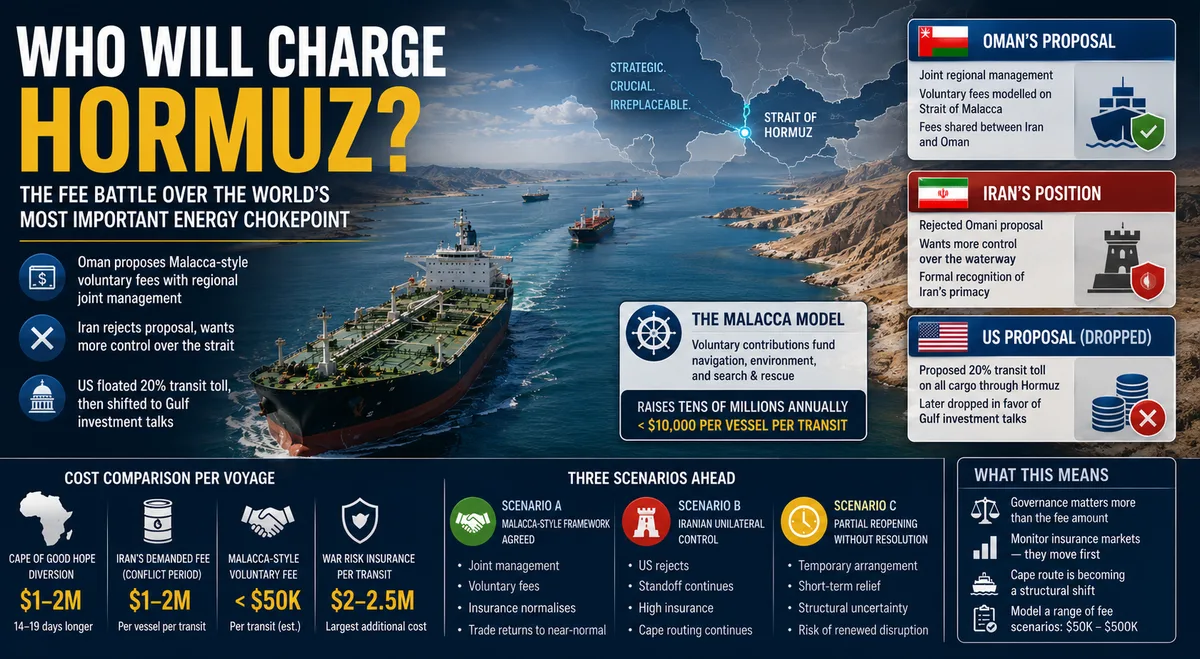
On July 28, Reuters reported that Oman had presented Iran with a Gulf-backed proposal for joint regional management of the Strait of Hormuz, including a system of voluntary fees modelled on the Strait of Malacca. Iran's Deputy Foreign Minister Kazem Gharibabadi confirmed on July 29 that Tehran had received the proposal — and rejected it, countering with its own framework that would give Iran more control over the waterway. Meanwhile, the United States briefly floated a 20% transit toll on all cargo through Hormuz in mid-July before abandoning the idea in favour of Gulf investment discussions. The result is a three-way negotiation over who administers the world's most important energy shipping chokepoint — with shipping companies and shippers caught in the middle.
What Oman Actually Proposed
Oman has presented a proposal to Iran for a joint regional mechanism to manage the Strait of Hormuz with voluntary fees, according to a Gulf source told to Reuters. Under the Omani proposal, which has regional backing, Iran would not exercise sole control of the vital waterway.
The proposal is based on the Strait of Malacca, between the Malay Peninsula and the Indonesian island of Sumatra, where those who use the strait voluntarily contribute to fund navigation, environmental protection and search and rescue. The Malacca model is the crucial reference point here. Under that framework — established in 2007 through a cooperative arrangement between Malaysia, Singapore, and Indonesia — shipping companies voluntarily contribute to a fund that finances aids to navigation, environmental protection, and maritime safety in the strait. The contributions are not mandatory, not paid to any single government, and not structured as a toll on cargo value. They are service fees for specific, defined services.
Additionally, the proposal suggested "voluntary fees" from shipping vessels that would go to both countries — Iran and Oman. The involvement of Oman as a co-recipient of fees is the key structural element that makes this proposal more palatable to the international shipping community than Iran's unilateral fee demand. It converts what Iran had framed as sovereign toll collection into a bilateral service arrangement — one that can at least be modelled on existing precedent without requiring the shipping industry to accept the principle that a sovereign state controls a strait used by 20% of the world's oil supply.
Why Iran Rejected It — And What Tehran Actually Wants
Iran's Deputy Foreign Minister Kazem Gharibabadi said in a state broadcast on July 29 that Oman's proposal had not sufficiently addressed Tehran's concerns about control of the strait. He added that Iran's counterproposal would give Tehran more control over the waterway.
Iran's core position has been consistent since the Persian Gulf Strait Authority was established in May 2026: formalising Iranian control over shipping through the strait — not just collecting fees for services, but being recognised as the authority that governs passage — is Tehran's most important strategic objective in this phase of the conflict. Reuters reporting on the fee dispute has described formalizing control of the strait as Tehran's most important goal in this phase of the conflict. Separate conflict tracking by the Institute for the Study of War and the Critical Threats Project has made the same judgment: Iranian officials have treated recognition of control over Hormuz as central leverage and deterrence, not a side demand.
The gap between Oman's proposal and Iran's position is therefore not primarily about money — it is about sovereignty. Iran wants the world to accept that it has the right to manage passage through Hormuz. The Oman proposal accepts Iran as a co-manager alongside Oman within a regional framework. Iran's counterproposal — the details of which have not been publicly disclosed — reportedly seeks to go further, establishing Tehran's primacy over the waterway rather than sharing it equally with a regional coalition.
What Trump Proposed — and Why It Was Dropped
President Donald Trump said the US will impose fees in the Strait of Hormuz "at the rate of 20% on all cargo shipped." Trump also said the US will reimpose its blockade of Iranian ports near the strait. That announcement, made in mid-July via Truth Social, was accompanied by language declaring America the "Guardian of the Strait" — framing the US as the authority that would collect and administer transit fees rather than Iran.
The 20% proposal was widely criticised as legally problematic and commercially extreme. "It's quite an extortionate level," said David Goldwyn, president of Goldwyn Global Strategies and a former US State Department special envoy. "If the US was able to safely escort ships and guarantee no threat from Iran, we would have seen that happen in the past few weeks." The US subsequently dropped the 20% toll concept in favour of Gulf investment discussions — but the episode matters because it established that Washington's stated opposition to Iranian fee collection is an objection to Iranian-controlled fees, not to fees in principle. That distinction is likely to shape the final framework, whatever form it takes.
The Malacca Model — What It Actually Costs Shipping
The Strait of Malacca comparison that underpins Oman's proposal is instructive — but it requires some honest scrutiny before shippers can model what a Hormuz fee might look like in practice.
The Malacca Strait voluntary contribution scheme, established through the Cooperative Mechanism in 2007, generates modest revenues. Musgrave noted that under the Strait of Malacca model, voluntary contributions raise very little, far from the $1 million per ship that's reportedly been proposed by Tehran as a "service fee" in the Strait of Hormuz. In practice, the Malacca scheme raises tens of millions of dollars annually, spread across the thousands of vessels transiting the strait each year — averaging well under $10,000 per ship per transit. Iran has previously demanded $1-2 million per vessel for Hormuz transit during the conflict period. The gap between those two numbers is enormous, and it is the central commercial disagreement that a final framework needs to resolve.
For context, here is how the fee scenarios compare against the cost of the Cape of Good Hope alternative:
- Cape of Good Hope diversion cost per voyage: Approximately $1-2 million in additional fuel, crew time, and opportunity cost for a large crude tanker on an Asia-Europe run — adding 14-19 days to transit.
- Iran's demanded fee during conflict period: $1-2 million per vessel per transit — comparable in cost to the diversion, but paid rather than avoided.
- Malacca-style voluntary fee: Potentially under $50,000 per transit if genuinely modelled on the Malacca scheme — commercially insignificant relative to the diversion cost.
- War risk insurance per Hormuz transit: Currently $2-2.5 million per voyage for the most exposed vessel types, according to trade press — the largest single additional cost associated with any Hormuz transit scenario involving ongoing conflict risk.
The commercial calculus for shipping companies, once a framework is agreed, is therefore driven less by the fee itself than by what the fee arrangement implies for war risk insurance. If a signed, functioning Hormuz management framework — even one with fees — convinces Lloyd's of London and the war risk market that the conflict risk is genuinely resolved, the premium reduction could be worth more than any fee. A $2 million war risk premium disappearing is worth more to a shipowner than a $1 million Malacca-style service fee costs.
Three Scenarios — What Happens Next
The current negotiation between Oman, Iran, and the US has three plausible outcomes — each with different implications for shipping costs and route planning:
- Scenario A — Malacca-style framework agreed: Iran and Oman jointly administer the strait, voluntary fees fund defined services, the US accepts the arrangement as consistent with freedom of navigation principles. War risk premiums normalise. Shipping resumes at near-normal volumes within weeks of signing. The fee is commercially modest. This is the outcome the Oman proposal is designed to achieve — and the one the shipping industry would most prefer.
- Scenario B — Iranian unilateral control framework: Iran insists on primacy, the US rejects the arrangement, the standoff continues. Hormuz remains partially closed. Cape of Good Hope routing continues as the default for risk-averse operators. War risk premiums stay elevated. The fee dispute becomes a prolonged deadlock. This is the outcome Iran's counterproposal appears designed to achieve.
- Scenario C — Partial reopening without resolution: A temporary arrangement allows some shipping to resume while the governance question remains unresolved — similar to the June MOU that ultimately collapsed. Short-term commercial relief, structural uncertainty, and recurring disruption risk. This is the most likely near-term outcome given the pace of current negotiations.
What This Means for Shippers and Logistics Operators
- The fee question matters less than the governance question. Whether ships pay $50,000 or $500,000 to transit Hormuz is important but not decisive for global freight costs. What matters is whether a signed, enforceable framework restores war risk insurance to normal levels and eliminates the operational uncertainty that has been driving routing decisions since February. A moderate fee with stable governance is commercially far superior to no fee with continued conflict risk.
- Don't assume the Malacca analogy holds in practice. The Omani proposal uses Malacca as a model, but Iran's counterproposal gives Tehran more control — and the final number is unlikely to resemble Malacca's modest contributions. Model a range of fee scenarios from $50,000 to $500,000 per transit and assess the impact on your specific cargo economics before concluding that Hormuz reopening automatically means lower freight costs.
- Insurance is the key variable to watch. Monitor Lloyd's and the war risk market closely as the negotiation develops. Insurance pricing will move before any official framework announcement — a significant softening in premiums signals that underwriters believe a workable framework is imminent. That is more reliable than diplomatic statements.
- The Cape of Good Hope is not a temporary solution anymore. Six Saudi supertankers are already routing around Africa. The DP World 50-year Fujairah terminal deal signals that major operators are building around Hormuz for decades, not waiting for it to reopen next month. Even if Hormuz reopens with fees, some trade flows that have reorganised around the diversion may not return. Build that structural shift into your network planning.
Key Takeaways — August 3, 2026
- Oman presented Iran with a Gulf-backed proposal on July 28 for joint regional management of the Strait of Hormuz, including voluntary fees modelled on the Strait of Malacca, backed by GCC states.
- Iran rejected the Omani proposal on July 29, with Deputy Foreign Minister Gharibabadi saying it did not sufficiently address Tehran's concerns about control — and countering with a proposal giving Iran more control.
- The US briefly proposed a 20% transit toll in mid-July before abandoning the idea — establishing that Washington objects to Iranian-controlled fees, not to fees in principle.
- The Malacca model that underpins Oman's proposal generates very little in voluntary contributions — far below Iran's reported demand of $1 million per vessel per transit.
- For shipping companies, the commercial value of any framework depends less on the fee itself and more on whether it convinces the war risk insurance market to normalise premiums — currently $2-2.5 million per Hormuz transit.
- Three scenarios are plausible: Malacca-style joint framework (best for shipping), Iranian unilateral control (prolonged standoff), or temporary partial reopening without governance resolution (most likely near term).

Comments
No comments yet. Be the first to share your thoughts!