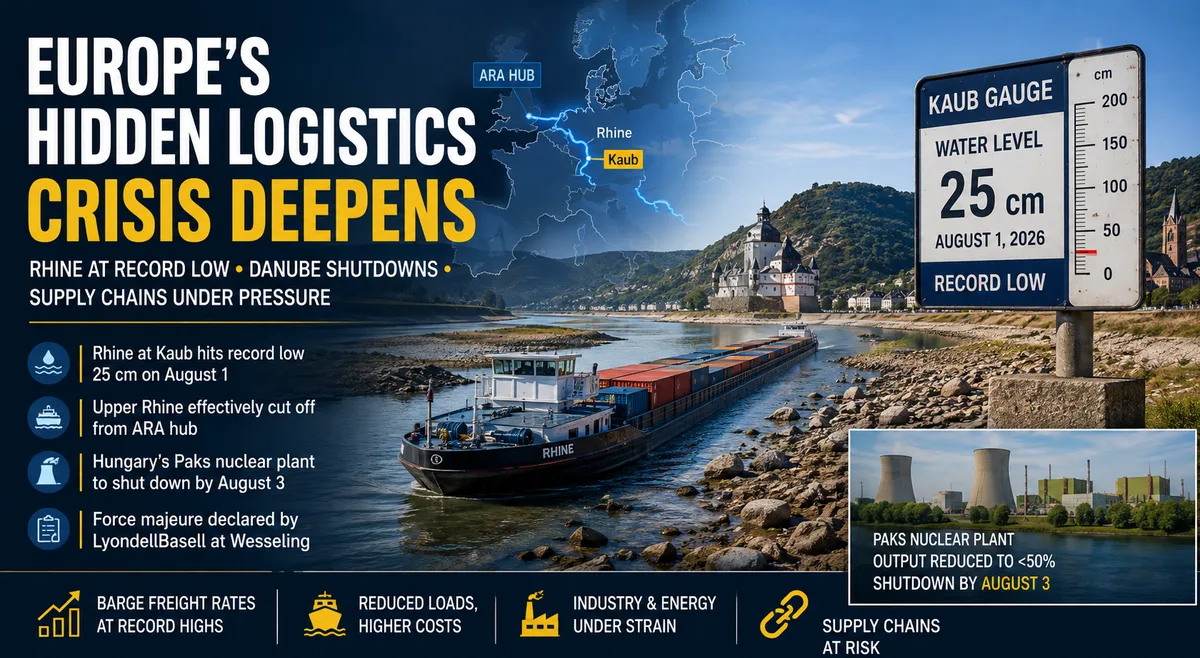
Europe has a second logistics crisis running alongside the Hormuz disruption — and it is moving faster than most supply chain planners anticipated. The Rhine River's water level at the Kaub chokepoint in Germany matched the all-time record low of 25 centimetres on August 1, according to Germany's Rhine Waterways and Shipping Office — the same level reached in October 2018 after months of drought, but reached this year in early August, weeks ahead of the traditional low-water season. The implications for European inland freight, chemical supply chains, and energy infrastructure are severe and worsening.
Why Kaub Is the Number That Matters
The Kaub gauge on the Middle Rhine between Koblenz and Mainz is not just a water level reading. It is the single most important chokepoint on one of Europe's most critical freight corridors — the river system connecting the Amsterdam-Rotterdam-Antwerp (ARA) seaport hub to the industrial heartland of Germany, France, and Switzerland.
Vessels need a navigable water depth of approximately 1.5 metres at Kaub to sail fully loaded. At 25 centimetres, the gap between current conditions and minimum operational depth is enormous. Cargo ships are not stopping — operators told Reuters they are continuing sailings — but they are doing so with drastically reduced loads. Industry analysts at Argus reported that most inland vessels were unable to pass the Kaub bottleneck at all by July 27. Those that could navigate the river were carrying a fraction of their normal cargo capacity, with some vessels at 25% of their load rating.
The DIHK — Germany's national chamber of commerce — described conditions in plain terms: "The low water levels on the Rhine and many other rivers are currently massively slowing freight transport." The consequence is not that freight stops. It is that the same amount of cargo requires more vessels, more trips, and more cost to move. Rhine barge freight rates have surged to record levels, according to Argus and commodity market intelligence provider ICIS.
The Upper Rhine Is Effectively Cut Off
The most operationally significant assessment in current market reporting came from Argus, which told clients directly: "In practice, the Upper Rhine and the Main rivers are now effectively cut off from the Amsterdam-Rotterdam-Antwerp (ARA) trade hub." That is not a forecast of what might happen — it is a description of current conditions as of late July.
The ARA hub is where bulk commodities, petroleum products, chemicals, and containerised cargo arrive by sea before moving inland via barge to Germany, France, Switzerland, and beyond. When the connection between ARA and the Upper Rhine is effectively severed by low water, it creates a two-directional pressure: cargo piles up at ARA waiting for conditions to improve, while inland factories and industrial facilities face supply disruption. The German steel industry's trade associations — the Circular Metal Association and the Federal Association of Secondary Raw Materials — warned on July 28 that scrap supply to German steelmakers has been "virtually at a standstill" on some river sections, with the Rhine and Danube both affected.
The Danube Crisis — Hungary's Nuclear Plant Is Shutting Down
While the Rhine situation is severe, the Danube is generating an even more acute short-term crisis. Hungary's Paks nuclear power plant — which normally provides approximately 50% of Hungary's electricity — has been forced to reduce output to less than 50% of capacity because the Danube water level is too low to provide sufficient cooling water. Hungarian Prime Minister Peter Magyar announced on August 1 that the plant is expected to be shut down completely as early as Monday August 3, with water levels forecast to keep falling.
A nuclear power plant shutdown driven by river drought is not a logistics story in isolation — but it is a supply chain story. Hungary's industrial production, grid stability, and energy-intensive manufacturing sectors are all directly affected by what happens at Paks. The Danube also serves as a freight corridor for Central and Eastern European trade flows, meaning the same drought conditions that are shutting down Hungary's main power source are simultaneously disrupting the freight network that serves it.
Force Majeure — The First Corporate Casualty
LyondellBasell — one of the world's largest petrochemical companies — declared force majeure on butadiene supplies from its Wesseling plant in Germany, according to ICIS. The force majeure is directly linked to the Rhine low-water situation: feedstock deliveries of naphtha and LPG from North Sea ports to inland chemical plants depend on barge transport through the Rhine corridor, and at current water levels those deliveries have been severely restricted.
LyondellBasell's force majeure is likely the first of several. The chemical and petrochemical industries are structurally dependent on Rhine barge transport for raw material supply — naphtha, LPG, ethylene, and other feedstocks move by barge from ARA to inland plants that cannot easily source the same materials by alternative modes at equivalent cost or speed. BASF's massive Ludwigshafen complex on the Rhine — the world's largest integrated chemical site — has faced Rhine low-water disruption in previous drought years and will be monitoring conditions closely.
Why 2026 Is More Severe Than 2018 and 2022
The 2018 Rhine drought remains the benchmark for European inland freight disruption. The Kaub gauge fell to a record low of 25 centimetres in October 2018 — but the drought developed slowly through summer before peaking in autumn. The 2022 drought saw Kaub fall to 32 centimetres in August, with disruption lasting several weeks before autumn rains restored normal levels.
What makes 2026 different is the timing. Kaub matched the 2018 record of 25 centimetres in early August — the same level that took until October 2018 to reach. That means the drought has developed faster and earlier than any previous year on record, and the traditional low-water season — which historically peaks in late summer and early autumn — has not yet begun. If dry weather persists through August and September, conditions could surpass 2018's record lows and extend the disruption into Q4 — exactly when European industry is ramping up for the end-of-year demand cycle.
Freight Perspectives, a specialist river freight analytics provider, noted that Kaub was at approximately 40 centimetres in mid-July 2026 — already historically low for that time of year — and forecast that the 2018 record was "within reach this summer" if dry conditions persisted. That forecast has now been confirmed. The question is whether conditions continue to deteriorate through August or whether rainfall provides relief before the situation becomes structurally damaging to German industrial output.
What This Means for Shippers and Supply Chain Operators
- Any supply chain dependent on Rhine barge transport needs an immediate mode review. At current water levels, barge capacity is severely constrained and rates are at record levels. Rail and road alternatives are available but more expensive and face their own capacity limits as freight shifts modes. Companies that have not already assessed alternative routing options should do so now, before conditions potentially worsen through August.
- Chemical and petrochemical supply chains are the most exposed. The Rhine is the primary feedstock delivery corridor for a large portion of European chemical production. LyondellBasell's force majeure is a leading indicator — not an isolated incident. Procurement teams sourcing chemicals and petrochemical derivatives from German and Swiss producers should be assessing supply security now.
- Energy supply in Central Europe is under stress. Hungary's Paks nuclear shutdown adds an electricity supply dimension to the drought's impact. For energy-intensive manufacturers in Hungary and neighbouring countries, grid stability is now a supply chain risk alongside raw material availability.
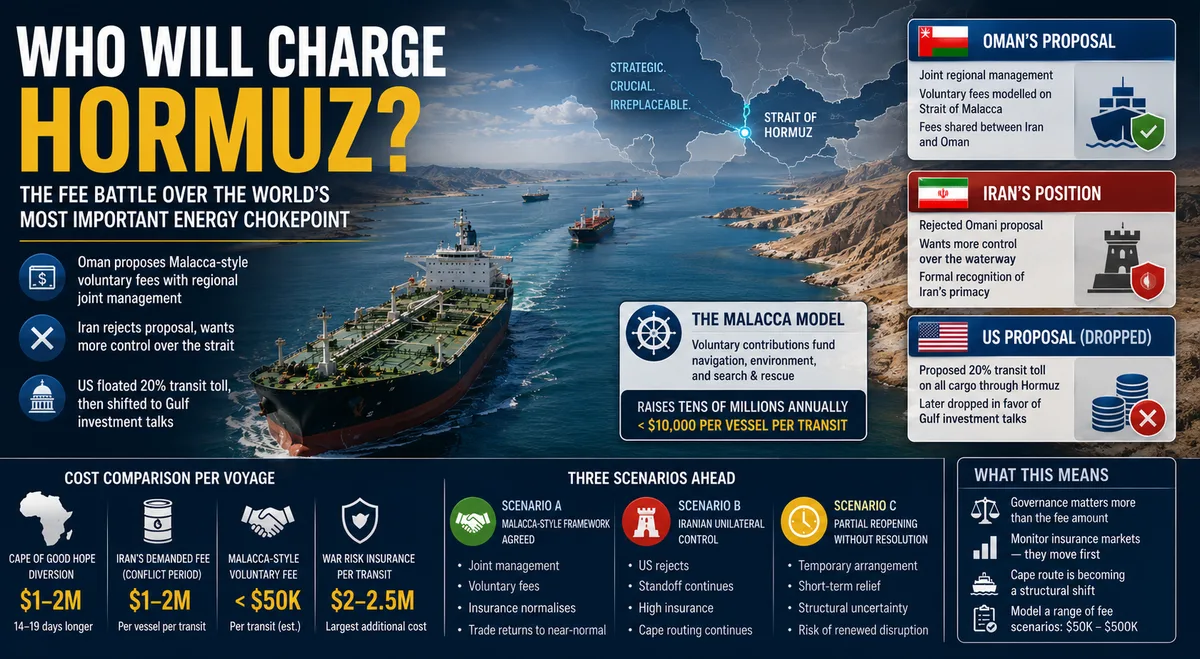
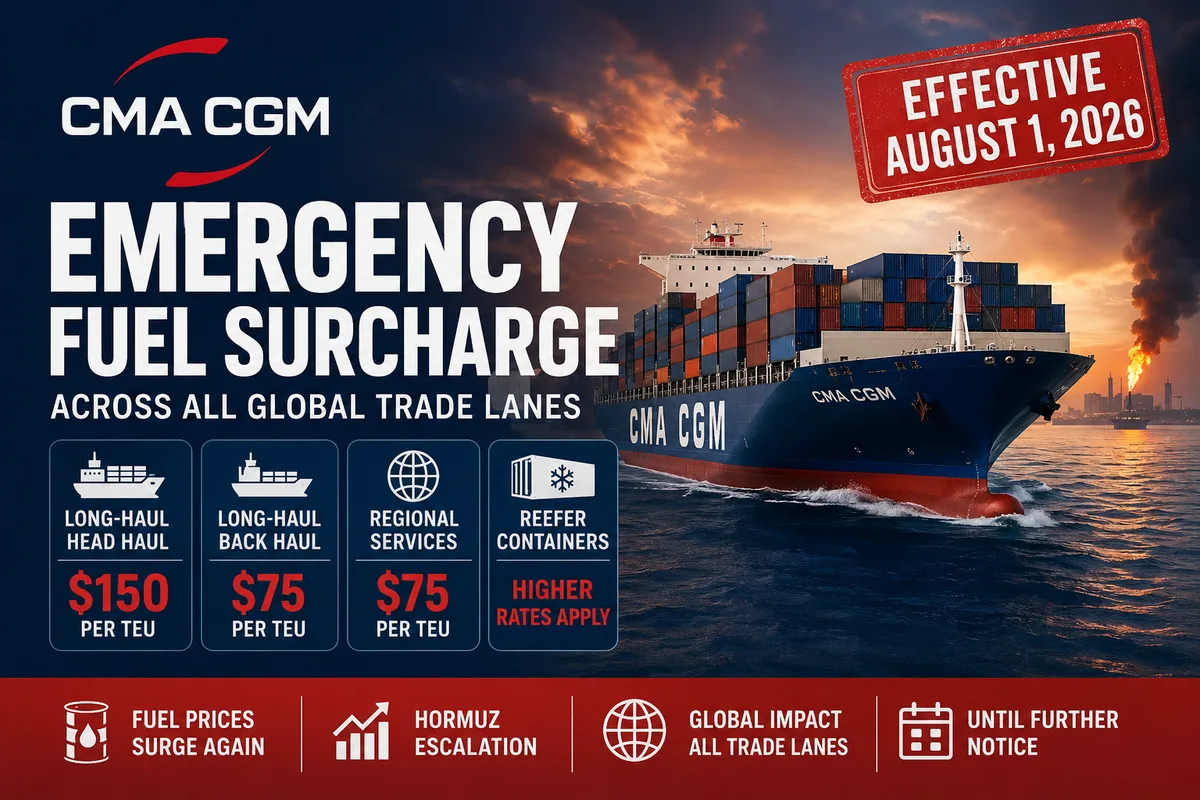
- The timing relative to Hormuz matters. Europe is simultaneously managing Hormuz-driven ocean freight disruption — elevated fuel costs, rerouted vessels, CMA CGM emergency surcharges — and a domestic inland freight crisis from river drought. The two are not directly connected, but they compound each other: companies trying to manage higher ocean freight costs now face additional inland distribution challenges on top of them.
- Watch the 14-day weather forecast, not just today's water level. The Kaub gauge responds to rainfall with a lag of several days. If extended rainfall is forecast for the Rhine catchment area — Switzerland, southern Germany, France — water levels will recover within a week to ten days. Persistent dry weather means conditions deteriorate further. The German Federal Institute of Hydrology publishes 14-day probabilistic forecasts for the Rhine — that is the most relevant data point for supply chain planning right now.
Key Takeaways — August 2, 2026
- The Rhine at Kaub matched its all-time record low of 25 centimetres on August 1 — the same level reached in October 2018, but reached this year in early August, weeks before the traditional low-water season peaks.
- The Upper Rhine and Main rivers are "effectively cut off" from the Amsterdam-Rotterdam-Antwerp trade hub, according to commodity intelligence provider Argus.
- LyondellBasell declared force majeure on butadiene supplies from its Wesseling plant in Germany — the first major corporate casualty of the 2026 Rhine drought.
- Hungary's Paks nuclear power plant — normally providing 50% of Hungary's electricity — is expected to shut down completely as early as August 3 due to insufficient Danube cooling water.
- Barge freight rates on the Rhine are at record levels as constrained capacity forces operators to use more vessels for the same cargo volume.
- The drought is developing faster and earlier than 2018 or 2022 — if dry conditions persist through August and September, the 2026 Rhine drought could surpass previous records and extend disruption into Q4.

Comments
No comments yet. Be the first to share your thoughts!