For weeks, shippers had been cautiously optimistic. Bunker fuel prices had been easing, container spot rates were declining for the third consecutive week, and some analysts were beginning to talk about a post-peak-season freight market that might finally give importers a break. As of today, August 1, 2026, that optimism has a surcharge attached to it.
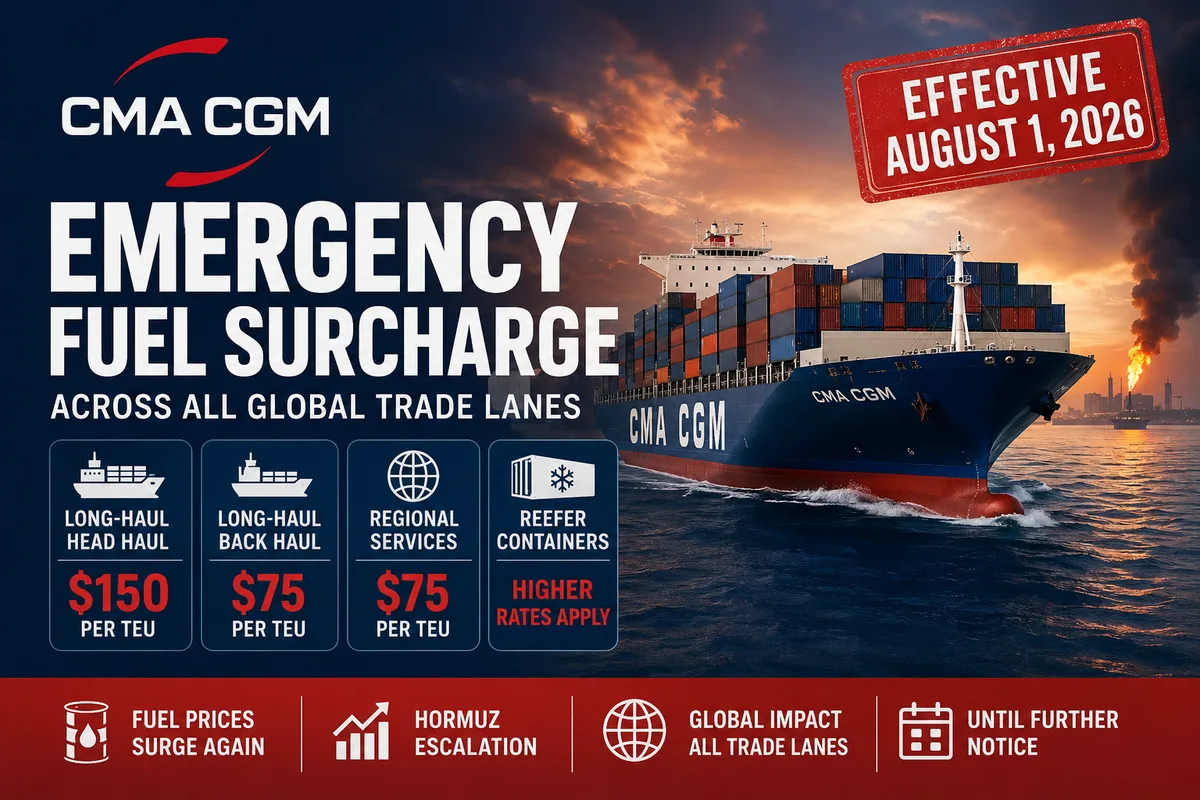
CMA CGM — the world's third-largest container carrier, operating one of the most extensive global liner networks — has implemented an Emergency Fuel Surcharge (EFS) effective today on all global trade lanes. The surcharge ranges from $65 to $165 per container depending on the trade lane and container type, and will remain in place until further notice. The carrier was explicit about the cause: "Following the renewed escalation of hostilities in the Strait of Hormuz over the past days, fuel prices have surged sharply again, reversing the easing observed in recent weeks. As a result, bunker costs have significantly increased across all regions and trades, impacting the overall cost of ocean transportation."
What the Surcharge Actually Costs — The Full Rate Schedule
CMA CGM's Emergency Fuel Surcharge is not a flat fee. It varies by trade lane direction and container type, following the standard surcharge structure the carrier has used throughout the Hormuz crisis. Based on the official notice published on CMA CGM's newsroom and confirmed by Container News, the surcharge structure is as follows:
- Long-haul head haul services: $150 per TEU (dry containers) — these are the primary Asia-Europe, Asia-US, and transpacific lanes where cargo moves in the main commercial direction
- Long-haul back haul services: $75 per TEU (dry containers) — return legs on the same major trade lanes
- Regional services: $75 per TEU — shorter intra-regional routes including intra-Asia, intra-Europe, and other regional services
- Refrigerated containers (reefer): Higher rates apply, consistent with the additional fuel intensity of temperature-controlled cargo
- Effective date: August 1, 2026, based on loading date — cargo loading from today onward is subject to the surcharge regardless of when it was booked
The surcharge applies across all CMA CGM brands and services globally. CMA CGM said it will remain in place "until further notice" and that it will continue to monitor fuel market conditions, adjusting the surcharge as necessary. Given the conflict's history — in which the carrier has revised surcharge levels multiple times since February — "until further notice" should be read as "until the fuel market changes significantly in either direction."
Why This Surcharge Matters More Than Previous Ones
CMA CGM has imposed multiple fuel surcharges since the Hormuz conflict began in February. This one is different in a specific and important way: it comes after a period of genuine easing that shippers had begun to plan around.
As NavilinkGlobal reported on July 23, ocean freight rates had declined for the first time since April, with Asia-US West Coast rates down 6% and carriers abandoning planned July 15 rate increases. Bunker fuel prices had fallen from their June peak. The market was showing the first signs of post-peak-season softening. Shippers who locked in contracts or adjusted their freight budgets based on that easing are now facing an unexpected reversal — not from market forces, but from a single geopolitical event: the resumption of US-Iran strikes and Iran's retaliatory actions in the last week of July.
Lars Jensen, president of Vespucci Maritime and one of the container shipping industry's most widely cited analysts, commented directly on the broader context in which this surcharge lands: the latest US-Iran attacks represent "a clear worsening of the maritime situation in the region," particularly as the Houthis attacked a tanker in the Red Sea for the first time since September — the same week the Damietta port drone strike opened a potential new front on Egypt's Mediterranean coast.
What This Means for Every Shipper Using CMA CGM
The practical implications of today's surcharge depend on where your cargo is and what agreements you have in place:
- Cargo loading from today onward is subject to the new EFS. The surcharge applies based on loading date — not booking date, not bill of lading date. If your cargo loads from a CMA CGM vessel on or after August 1, the surcharge applies even if you booked the shipment weeks ago at a rate that didn't include it. Check your booking confirmations and rate agreements for how surcharge pass-through is handled.
- Cargo already loaded is not affected. If your shipment was loaded before August 1, the surcharge does not retroactively apply to that cargo. Cargo currently at sea is subject to the rates in force at time of loading.
- Index-linked contracts need immediate review. If your freight contract includes a bunker adjustment mechanism or links rates to a published fuel index, the August 1 EFS may trigger automatic adjustments beyond the stated surcharge. Review your contract language against CMA CGM's official advisory.
- Other carriers are likely to follow. CMA CGM is historically one of the first major carriers to announce surcharges following fuel cost spikes — and competitors typically follow within days. Shippers using Maersk, MSC, Hapag-Lloyd, Evergreen, or other lines should expect similar announcements in the coming 48-72 hours. The surcharge is a market-wide cost structure event, not a CMA CGM-specific one.
- Budget your August freight costs upward immediately. At $150 per TEU on main lane head haul, a shipper moving 100 TEUs per month on Asia-Europe or Asia-US lanes is now facing an additional $15,000 per month in surcharge cost — on top of whatever spot rates or contract rates are already in place. This is not a rounding error; it is a material freight cost increase that requires immediate budget revision for any company with significant containerized import or export volumes.
The Broader Signal — What This Surcharge Tells You About the Market
Fuel surcharges are not just a cost item. They are a real-time signal about how carriers are assessing the operating environment — and CMA CGM's August 1 EFS carries information beyond the per-container dollar amounts.
First, it confirms that the fuel cost easing of June and early July has been fully reversed. The Hormuz escalation, the Houthi expansion of maritime attacks to Saudi Arabia's Yanbu route, and the Damietta port strike have collectively pushed bunker costs back to levels that require emergency cost recovery — not a routine bunker adjustment factor update, but a separately declared emergency surcharge. That language signals a step-change in operating conditions, not a gradual trend.
Second, the "until further notice" duration signals that CMA CGM's operational planners do not expect the underlying cause — Hormuz disruption and elevated fuel prices — to resolve on a predictable timeline. Emergency surcharges with defined end dates are common in short-term disruptions. Open-ended ones signal that the carrier expects the disruption to persist for a period it cannot forecast.
Third, the surcharge reinforces the analysis this page has been tracking since July 22: the Hormuz conflict is no longer just a routing problem for vessels calling at Gulf ports. It is now a fuel cost problem for every vessel on every trade lane globally. Bunker fuel is priced globally. When Hormuz disruption pushes global oil prices up, every ship on every route — including those that never pass within 5,000 miles of the strait — burns more expensive fuel. That is what CMA CGM's August 1 EFS is charging for.
Key Takeaways — August 1, 2026
- CMA CGM implemented an Emergency Fuel Surcharge effective today, August 1, 2026, across all global trade lanes — $150/TEU head haul, $75/TEU back haul and regional services.
- The surcharge is directly linked to the renewed Hormuz escalation reversing recent fuel price easing. It applies until further notice.
- The EFS applies based on loading date — cargo loading from today onward is subject to the surcharge regardless of booking date.
- Other major carriers are expected to announce similar surcharges within 48-72 hours — this is a market-wide development, not a CMA CGM-specific one.
- At $150/TEU on main lane head haul, shippers moving significant container volumes face a material budget impact that requires immediate revision of August freight cost forecasts.
- The surcharge signals that CMA CGM's operational planners do not expect the Hormuz disruption — and its fuel cost consequences — to resolve on a predictable timeline.

Comments
No comments yet. Be the first to share your thoughts!