What Happened — The Simple Version
Here is the story in plain English:
Earlier this year, the US Supreme Court ruled that President Trump did not have the legal authority to impose his original "Liberation Day" tariffs — the sweeping import taxes he announced in April 2025. The court struck them down in February 2026.
To fill the gap, Trump put in place a temporary 10% tariff on most imports. But that temporary tariff was set to expire today — July 24, 2026.
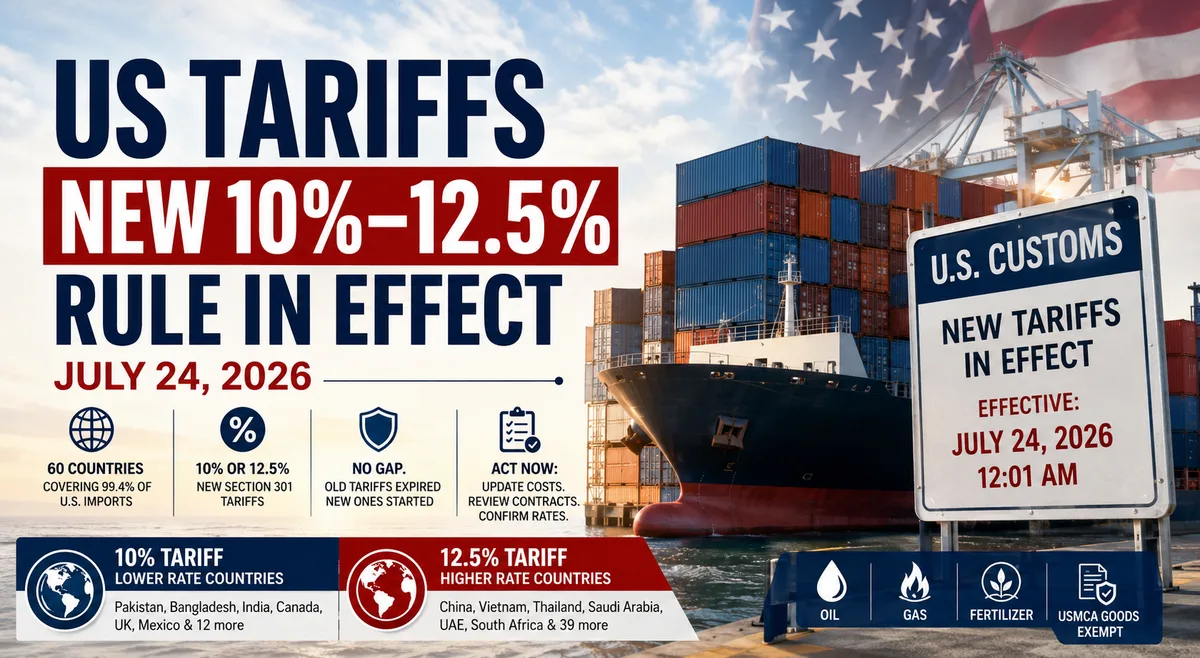
So what did Trump do? He turned to new trade laws as earlier authorities expired, announcing a new round of tariffs up to 12.5% on 60 trading partners, preventing a lapse in import taxes as the temporary tariff program neared expiration.
The new tariffs went into effect at 12:01 AM on July 24, 2026 — the exact moment the old ones expired. There was no gap. The old tariffs ended and the new ones began at the same second.
Which Countries Are Affected — And What Rate?
The United States will slap taxes of 10% to 12.5% on imports from 60 trading partners accounting for 99% of US imports. Here is the breakdown:
10% Tariff Countries (Lower Rate)
Countries subject to a 10% tariff include Argentina, Bangladesh, Britain, Cambodia, Canada, Ecuador, El Salvador, Guatemala, Honduras, India, Indonesia, Jordan, Malaysia, Mexico, Pakistan, Sri Lanka and Trinidad and Tobago.
Why did these countries get the lower rate? Countries that have laws against the import of products made using forced labour received the lower 10% rate. In other words, countries that already had forced labor bans in place were rewarded with slightly lower tariffs.
12.5% Tariff Countries (Higher Rate)
The remaining 43 countries face 12.5% tariffs. These include China, accused by the US of detaining Uyghur minorities in work camps, which Beijing denies. Also included are Vietnam, Thailand, Saudi Arabia, UAE, South Africa, and dozens more.
EU, Japan, South Korea, Taiwan, Switzerland
The European Union, Taiwan, Japan, South Korea and Switzerland were assigned rates that, combined with pre-existing most-favoured-nation tariff rates, would total 10% or 12.5%. These countries have existing trade agreements with the US that cap total tariff levels — so the new tariff is calculated to bring their total rate to either 10% or 12.5%, not add on top of it.
What Is Exempt?
Not everything is being taxed. Certain products, including oil, gas, fertilizer and many goods qualifying for duty-free treatment under the US-Mexico-Canada Agreement, are exempt. Products that cannot be sourced domestically in the US also received exemptions.
Why Is Trump Doing This — The "Forced Labor" Justification
The legal basis for these new tariffs is completely different from the previous ones. This time, Trump is using Section 301 of the Trade Act of 1974 — a much more durable legal tool that has survived court challenges for decades.
USTR Ambassador Jamieson Greer said: "President Trump recognizes that decades of moral suasion have not eradicated forced labor from global supply chains. The United States has had a forced labor import ban for nearly a century, and rigorously enforces it; it's well past time for our trading partners to do the same."
The official White House position is that all 60 countries have failed to properly ban or enforce bans on goods made using forced labor — and that gives the US the right to impose tariffs on them under Section 301.
Critics disagree. A grassroots coalition of small businesses said the administration was pointing to labor violations as a flimsy pretext to backfill its tariffs that could not survive legal or legislative scrutiny.
The EU was particularly vocal. The European Union questioned the new tariff, with its foreign policy chief Kaja Kallas calling it a "negative surprise" and rejecting the forced labor claims as unfounded. Brazil also rejected its tariff rate. But the tariffs went into effect regardless.
How Is This Different From the Previous Tariffs?
This is important for importers to understand — these are NOT the same tariffs as before. Here are the key differences:
- Different legal authority. Previous IEEPA tariffs were struck down by the Supreme Court. These new tariffs use Section 301 of the Trade Act of 1974 — a law that has been used for decades and is much harder to challenge in court.
- Different justification. The old tariffs were based on "national emergency" and trade deficits. The new ones are based on "forced labor" enforcement failures.
- They do NOT stack on existing tariffs. The new tariffs would not "stack" on top of existing import taxes on steel and aluminum, known as "Section 232" duties, that Trump imposed on national-security grounds.
- China's rate is now 12.5% — but more increases are coming. Trump administration officials have told Chinese counterparts they intend to rebuild Trump's second-term tariffs on Chinese goods back up to the 20% that was agreed upon in a trade truce with Chinese President Xi Jinping in November 2025 — but not exceed that level.
What Does This Mean for Importers and Supply Chains?
For every company importing goods into the United States, today is a new starting point. Here is what changes immediately:
Your Cost of Goods Just Changed — Again
If you import from any of the 60 affected countries — and the list covers 99.4% of US imports, so almost certainly yes — you are now paying either 10% or 12.5% on top of any existing tariffs. For companies that were paying 10% under the temporary tariff, most rates stay the same or go slightly higher. For importers from China, the rate moves from 10% to 12.5%.
Customs Entries From Today Need New Duty Calculations
All goods that entered US customs from 12:01 AM on July 24 are subject to the new rates. If you have shipments currently at sea or in port, your customs broker needs to apply the new tariff rates to those entries. Do not assume the old rate still applies — it does not.
Supplier Contracts May Need Reviewing
If you have contracts with overseas suppliers that include price formulas based on tariff rates, a rate change triggers a review. For most importers, the change from 10% to 12.5% on Chinese goods is the most significant — that is a 25% increase in the tariff amount itself.
Section 301 Is More Legally Stable
One piece of relatively good news for importers: the administration said business leaders have been seeking more continuity and predictability around tariffs, and they have heard loud and clear: people want to know what tariff rate they're going to pay. Section 301 tariffs are harder to overturn than IEEPA tariffs. So while the rates may not be welcome, there is a reasonable expectation they will stay in place longer than the previous round.
What About Pakistan, Bangladesh, and India Specifically?
For logistics professionals serving South Asian trade lanes, here is the specific picture:
- Pakistan — 10%. Pakistan was placed in the lower tariff tier because it has laws against the import of products made using forced labour. This is the same rate as Canada and the UK.
- Bangladesh — 10%. Same lower tier. Bangladesh is a critical garment manufacturing country — this rate will directly affect the cost of clothing and textiles imported from Bangladesh into the US.
- India — 10%. On June 3, when the US had proposed tariffs under Section 301, India was bracketed among countries attracting 12.5% levies, but Washington took note of the amendment New Delhi made to its foreign trade policy prohibiting the import of goods produced using forced labour. India's quick policy change saved it from the higher rate.
What Should You Do Right Now — Step by Step
- Call your customs broker today. Confirm which tariff rate applies to your specific goods and country of origin. Your broker needs to apply the correct Section 301 rate — not the old IEEPA rate — from today.
- Check if your goods are exempt. Oil, gas, fertilizer, and USMCA-qualifying goods may be exempt. Your customs broker can confirm this quickly.
- Update your landed cost calculations. If you use any costing model that includes import duties, update it today. The rates are different — especially for Chinese goods moving from 10% to 12.5%.
- Review supplier contracts. If your contracts include duty adjustment clauses, a rate change triggers a renegotiation window. Check your agreements now.
- Do not confuse these with the IEEPA refunds. The $166 billion IEEPA refund process (which we covered in June) applies to the old tariffs that were struck down. These new Section 301 tariffs are separate — you cannot claim refunds on these.
- Monitor China rate closely. The 12.5% on China may not be the final number. The White House has signaled it wants to return Chinese tariffs to 20%. Plan your China sourcing costs assuming rates could rise further.
Key Takeaways — July 24, 2026
- New US tariffs of 10% to 12.5% hit 60 countries effective today, July 24, 2026 at 12:01 AM.
- Covers 99.4% of all US imports — almost nothing is excluded.
- Legal authority: Section 301 of the Trade Act of 1974 — much more durable than previous IEEPA tariffs.
- Justification: forced labor enforcement failures by trading partners.
- Pakistan, Bangladesh, India, Canada, UK — 10% rate (lower tier).
- China, Vietnam, Saudi Arabia and 40+ others — 12.5% rate (higher tier).
- Oil, gas, fertilizer, and many USMCA goods are exempt.
- China tariffs may increase further — White House targeting 20% on Chinese goods.
- These do NOT stack on top of steel/aluminium Section 232 tariffs.
- Action needed now: update duty calculations, review contracts, confirm rates with customs broker.
The tariff whiplash of 2025-2026 is not over. With Section 301 now the legal foundation, these tariffs are built on stronger legal ground than before — meaning importers should plan for them to stay. The rate may be 10% or 12.5% today. But the direction of travel — especially on China — suggests higher rates are possible ahead. Plan accordingly.

Comments
No comments yet. Be the first to share your thoughts!