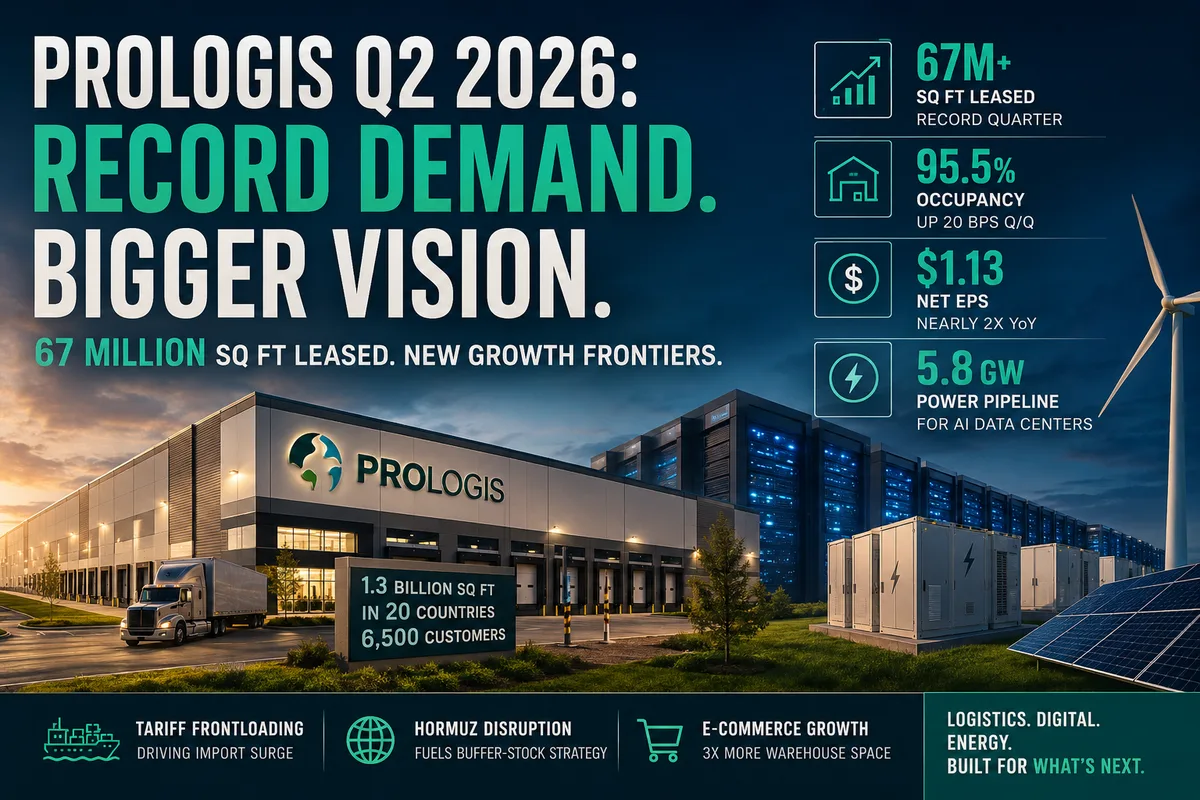
If you want to understand where the global logistics industry is actually heading — not where people say it's heading, but where the money is going — there's no better barometer than Prologis. The company owns 1.3 billion square feet of logistics real estate across 20 countries, serving approximately 6,500 customers including virtually every major retailer, e-commerce platform, third-party logistics provider, and manufacturer that moves goods at scale. When Prologis reports, the results are a snapshot of the entire industry's real estate appetite in one set of numbers.
On July 16, 2026, Prologis released its Q2 2026 results — and the headline figure was a record: the company signed over 67 million square feet of leases in a single quarter, the highest volume in its history. The company raised its full-year guidance for the second time in 2026, and revealed a strategic pivot that goes well beyond warehouses into AI data centers and energy infrastructure.
The Record Quarter — What the Numbers Say
The scale of Q2's leasing activity is best understood in context. Sixty-seven million square feet is roughly equivalent to the entire logistics footprint of a mid-sized European country — signed in three months. Occupancy across Prologis's owned and managed portfolio reached 95.5%, a 20 basis point improvement from the end of Q1, confirming that the leasing activity was filling real space, not just renewing existing contracts.
Financially, the results were equally strong. Net earnings per diluted share came in at $1.13, nearly double the $0.61 reported in Q2 2025. Core Funds from Operations — the metric logistics REIT investors watch most closely — reached $1.63 per share for the quarter and $3.00 per share for the first half of 2026. Total revenues for the first six months reached $4.72 billion, with net earnings of $2.04 billion. The company beat analyst earnings expectations by over 100%.
"We believe the business is entering its next phase of growth," said Prologis CEO Daniel S. Letter. "Customer demand is broadening, and our opportunity set is expanding as logistics, digital infrastructure and energy needs increasingly intersect. Given our scale and deep customer relationships, we are well positioned for this next cycle."
Why Demand Is Surging — The Supply Chain Context
The record leasing didn't happen in a vacuum. Three forces converged to drive unusual warehouse demand in Q2 2026, and all three are directly relevant to anyone managing a supply chain right now.
First, tariff-driven frontloading. As NavilinkGlobal reported on July 11, US container ports were on track for record import volumes in July as retailers and importers rushed to get inventory into the country before new tariffs take effect in August. Cargo arriving ahead of schedule needs somewhere to go — and that somewhere is warehouse space, particularly in the port-adjacent markets where Prologis has its densest footprint.
Second, the Iran-Hormuz conflict. With the Strait of Hormuz formally closed as of July 13 — an unprecedented step this page reported — supply chains have been disrupted across the Middle East, Asia-Europe, and oil-dependent trade lanes. Companies that rely on just-in-time inventory models are switching to buffer-stock strategies, which means holding more inventory on hand at all times. More inventory held means more warehouse space needed.
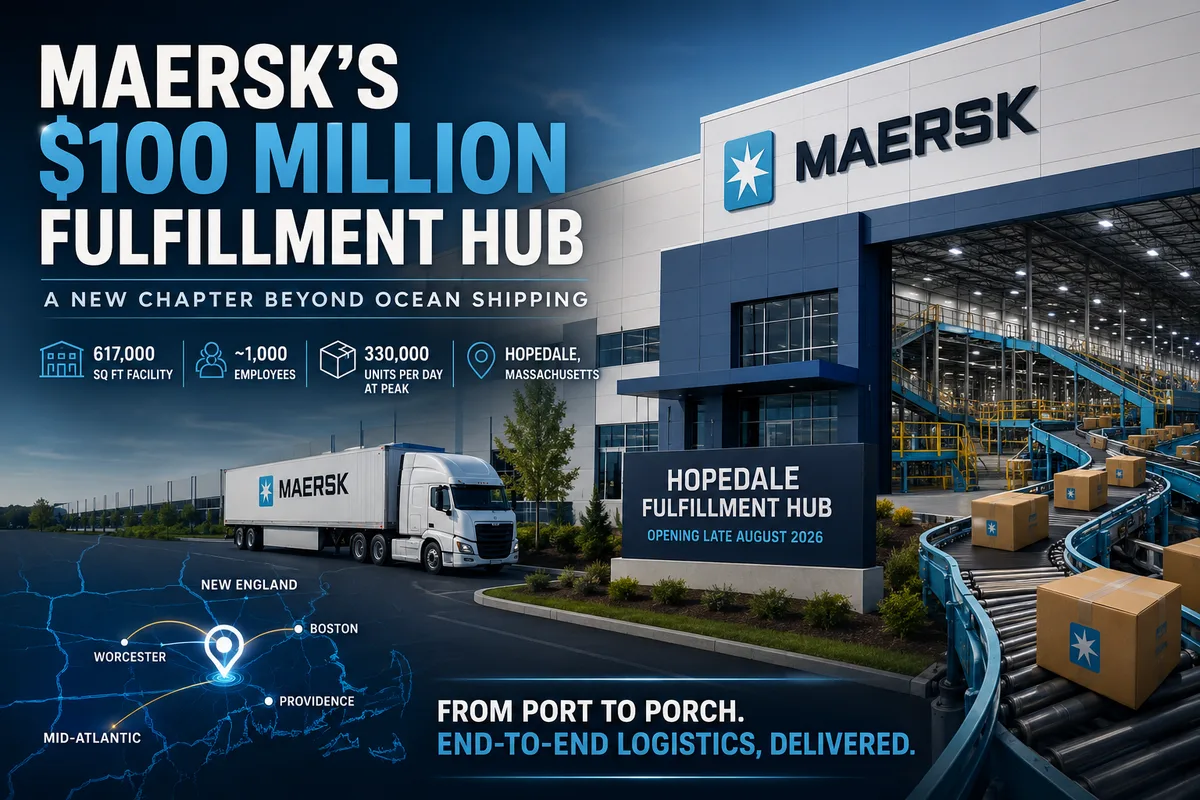
Third, e-commerce growth continues to outpace retail in both volume and warehouse intensity. E-commerce operations require three times the warehouse space of traditional retail for the same sales volume, a ratio Prologis has cited repeatedly. As major carriers including Maersk — which this page reported yesterday invested $100 million in a new Massachusetts fulfillment hub — expand into e-commerce logistics, the demand for quality logistics real estate follows directly.
The Pivot Nobody Expected: AI Data Centers
The most strategically significant element of Prologis's Q2 results isn't the record leasing — it's what the company is building next. Prologis disclosed a power pipeline of approximately 5.8 gigawatts of electricity capacity under development, positioned to serve AI data centers and energy infrastructure on its existing land bank.
The company has a 14,000-acre land bank representing 240 million square feet of embedded development opportunity across its existing sites. Rather than developing all of that capacity as traditional warehouse space, Prologis is increasingly converting or reserving portions for the power-hungry data center infrastructure that AI companies and hyperscalers are racing to build. The company started $1.6 billion of new development projects in Q2, and closed a $1.2 billion European joint venture — both reflecting expansion beyond its traditional warehouse model.
This move makes strategic sense for reasons directly relevant to the logistics industry. AI data centers require exactly the same things premium logistics facilities require: large flat land parcels with strong highway access, high power connectivity, and proximity to major population centers. Prologis already owns that land. Converting some of it to data center use — or developing hybrid logistics-plus-compute campuses — is a natural extension of its existing portfolio.
What This Means for Shippers and Logistics Providers
- Quality logistics real estate is getting scarcer and more expensive. A 95.5% occupancy rate across a 1.3 billion square foot global portfolio leaves very little slack. Companies that need to expand warehouse footprint quickly — whether to buffer inventory against tariff risk or to absorb frontloaded imports — are competing for a thin supply of available Class A space.
- Prologis's data center pivot will reshape availability in some markets. In land-constrained metros where Prologis has significant holdings, the conversion of logistics-zoned land to data center use reduces future warehouse supply. This is a medium-term dynamic, not an immediate shortage, but logistics real estate planners should factor it into 3-5 year site strategies.
- The warehouse-as-infrastructure thesis is now mainstream. Yesterday this page reported Maersk's $100 million fulfillment hub investment. Today Prologis reports a record leasing quarter. The two stories together confirm that logistics real estate — once a back-office cost center — has become a primary strategic asset, competed for by carriers, retailers, e-commerce platforms, and now AI companies simultaneously.
- Guidance raises signal confidence, not just performance. Raising full-year guidance twice in one year is a deliberate signal to the market that management sees durable demand, not a one-quarter spike. For supply chain planners trying to decide whether current warehouse tightness is temporary or structural, Prologis's guidance is a meaningful data point.
Key Takeaways — July 19, 2026
- Prologis signed a record 67 million square feet of leases in Q2 2026 — the highest quarterly leasing volume in the company's history.
- Portfolio occupancy reached 95.5%, up 20 basis points from Q1, across 1.3 billion square feet in 20 countries.
- Net earnings per diluted share nearly doubled year-over-year to $1.13; Core FFO reached $1.63 per share — beating analyst expectations by over 100%.
- The company raised its 2026 full-year guidance for the second time, citing broadening customer demand and expanding opportunity across logistics, digital infrastructure, and energy.
- Prologis revealed a 5.8 gigawatt power pipeline for AI data centers — a strategic pivot that will reduce available logistics land in some constrained markets over the medium term.
- Three converging forces drove Q2 demand: tariff-driven inventory frontloading, Hormuz-related supply chain disruption pushing companies toward buffer-stock strategies, and continued e-commerce warehouse intensity.


Comments
No comments yet. Be the first to share your thoughts!