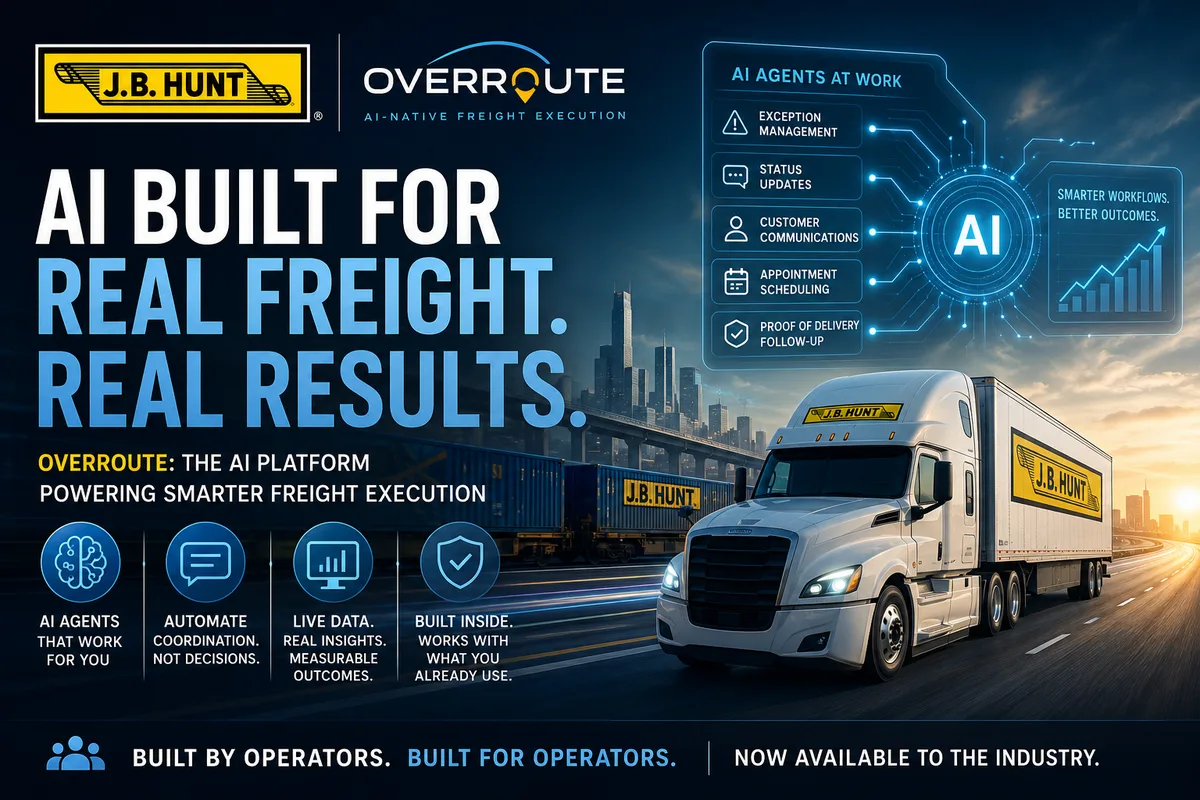
When a company the size of J.B. Hunt decides to build an AI company from the ground up inside its own freight network, it's worth paying attention. J.B. Hunt Transport Services — one of the largest supply chain solutions providers in North America, listed on Nasdaq and handling millions of loads annually — spent the past year co-designing an AI-native freight execution platform with UP.Labs, a startup creation initiative it announced in October 2024. The result is Overroute, which launched publicly on July 21, 2026.
Overroute isn't a pilot project or a venture bet. Before its public launch, it had already been deployed across every one of J.B. Hunt's business units — tested against the real complexity of one of the most demanding freight networks in the United States, including intermodal, dedicated contract services, truckload, and final mile. Now, for the first time, Overroute is available to other carriers and logistics operators beyond J.B. Hunt itself.
What Overroute Actually Does
The problem Overroute is built to solve is one every freight operator recognizes: the enormous volume of coordination work that happens around every single load. Status updates, exception management, customer communications, appointment scheduling, carrier check-ins, delay notifications, proof-of-delivery follow-ups — individually, each task is simple. Multiplied across thousands of loads per day, the manual workload becomes one of the largest drains on operational productivity in the industry.
Overroute deploys AI agents to handle that coordination layer automatically. Crucially, the platform is designed to work inside carriers' existing tools and workflows — not as a separate system that requires new software adoption or data migration. The agents read live data from existing systems, surface exceptions as they emerge, automate the routine communication tasks around each load, and escalate only the decisions that genuinely require human judgment.
"Our agents have been tested against the real complexity of enterprise logistics, including the exceptions, the edge cases, the change management, the human judgment calls," said Alex Reed, CEO of Overroute, in the official launch announcement. "We represent a new category in freight technology: Agentic AI built alongside J.B. Hunt operators, inside real freight workflows, with real data, real users and measurable outcomes."
That last phrase — "real data, real users and measurable outcomes" — is significant. Most AI freight tools launched in 2026 are built in isolation, trained on synthetic or third-party datasets, and tested in controlled environments. Overroute was built the other way around: deployed first inside one of the most operationally complex freight networks in North America, refined against real-world edge cases, and only then offered to the broader market. The difference between those two development paths matters significantly for how reliably the technology performs at scale.
Why J.B. Hunt Built Its Own AI Company
J.B. Hunt's decision to build Overroute through UP.Labs — rather than acquiring an existing AI freight tool or licensing third-party technology — reflects a strategic bet that the carriers who build proprietary AI capabilities will hold a durable competitive advantage over those who buy generic solutions.
Nick Hobbs, Chief Operating Officer of J.B. Hunt, described the logic plainly in the launch announcement: "We operate one of the most complex freight networks in North America, and that gives us a unique opportunity to take emerging technology and apply it at real scale. Overroute is an example of a broader strategy where we're using AI as a force multiplier within our expansive network to reduce friction and improve how freight gets executed every day."
The timing is deliberate. J.B. Hunt reported second-quarter 2026 net earnings of $181 million, with diluted EPS of $1.91 versus $1.31 in Q2 2025 — a 46% year-on-year earnings improvement. Its intermodal segment posted a 22% revenue increase to $1.75 billion, driven by strong demand as carriers and shippers sought alternatives to road freight amid rising fuel costs. Company executives said they had spent four years preparing for the current freight market conditions — and that Overroute is part of capitalising on that preparation, not a reaction to it.
What Makes This Different From Other AI Freight Tools
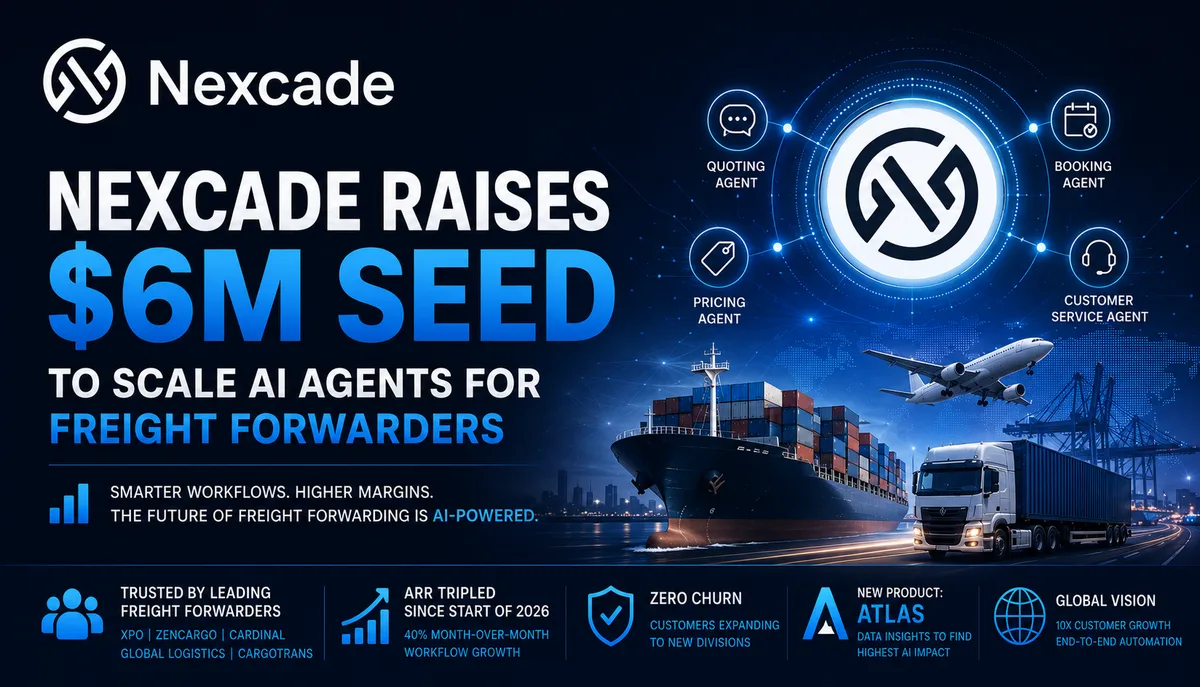
The logistics AI space in 2026 is crowded. As this page has reported throughout the year, SAP deployed autonomous supply chain agents in May, Nexcade raised $6 million to automate freight forwarding inboxes in July, and dozens of smaller tools promise to automate various parts of the freight workflow. So what distinguishes Overroute?
Three things set it apart from the majority of tools currently in the market.
First, it was built inside an operating carrier rather than alongside one. Overroute's AI agents were not designed in a lab and then deployed at J.B. Hunt — they were designed by being deployed at J.B. Hunt, refined by operators who use them on real loads every day, and shaped by the exception patterns that actually occur in a network of J.B. Hunt's scale and complexity. That training environment is essentially impossible to replicate synthetically.
Second, it targets the coordination layer rather than the decision layer. Most freight AI tools currently available focus on rate prediction, route optimization, or demand forecasting — decisions that happen before a load moves. Overroute focuses on what happens after a load is confirmed: the continuous stream of coordination tasks that run from pick-up to proof-of-delivery. This is arguably the most labour-intensive part of freight operations, and the least automated.
Third, it is designed to work inside existing systems rather than replace them. Carriers and logistics operators have made significant investments in their transportation management systems, visibility platforms, and communications tools. Overroute reads from and acts within those existing environments rather than requiring operators to adopt a new platform — which substantially reduces the implementation barrier and the change management burden.
What This Means for Carriers, Brokers and Logistics Operators
Overroute's public launch marks a meaningful shift in how AI is entering the freight industry — not through venture-funded startups selling to enterprises, but through operating carriers building AI tools for themselves and then commercialising them. That model has significant implications for the competitive landscape:
- Carriers that build proprietary AI gain a compounding advantage. Every load that runs through Overroute generates data that improves the model. J.B. Hunt has already run millions of loads through the system before its public launch. Any competitor starting from scratch today begins with a significant data deficit — one that compounds over time rather than closing.
- The coordination layer is becoming the new competitive frontier. Rate competitiveness, asset utilisation and route efficiency are table stakes in modern freight. The carriers that differentiate on operational execution — speed of exception resolution, quality of customer communication, accuracy of status updates — are increasingly the ones winning and retaining enterprise shipper contracts. Overroute targets exactly that layer.
- Small and mid-sized carriers can now access enterprise-grade AI. Overroute's decision to open the platform to carriers beyond J.B. Hunt means that the same AI tools running inside one of North America's largest freight networks are now available to operators who could never have built equivalent technology independently. That has real implications for the competitive dynamics of the broader carrier market.
- The UP.Labs model signals more is coming. Overroute is described as the first startup to emerge from J.B. Hunt's partnership with UP.Labs. That framing — "the first" — suggests additional AI products are in development under the same initiative. Carriers and brokers paying attention to J.B. Hunt's technology strategy should treat Overroute's launch as an opening move, not a complete picture.
Key Takeaways — July 25, 2026
- J.B. Hunt publicly launched Overroute on July 21, 2026 — an AI-native freight execution platform built over one year of co-design with UP.Labs and deployed across all of J.B. Hunt's business units before going public.
- Overroute deploys AI agents to automate the coordination layer behind freight loads — exception management, status updates, customer communications, and appointment scheduling — operating inside carriers' existing systems without requiring new software adoption.
- The platform is now available to carriers and enterprise logistics operators beyond J.B. Hunt, marking its first commercial expansion outside the carrier that built it.
- J.B. Hunt reported Q2 2026 net earnings of $181 million (+46% YoY) and intermodal revenue of $1.75 billion (+22% YoY) — providing the financial backdrop for its sustained technology investment.
- Overroute represents a new model for AI adoption in freight: built by operators for operators, trained on real network data, and commercialised after proven production deployment — rather than sold as a pilot to be proven later.
- Overroute is the first product from J.B. Hunt's UP.Labs initiative, which was announced in October 2024 with the stated goal of building multiple startups to address complex challenges in freight transportation.
Comments
No comments yet. Be the first to share your thoughts!